Today the paperback edition of Blind Spot released!
It has a
cool new cover. And I have to say, I was a bit surprised by that when first told it would be reprinting in paperback. I was in love with my original hardcover art. In a world where readers often do judge a book by its cover, I felt the original cover helped Blind Spot jump off the shelf. It was ‘eye-catching’ – pun intended!
Original hardcover art
Despite loving the original though, I did
fall in love with the paperback art too. The icy blue color scheme and the way the eye looks like it is peering through ice, fits the plot well. I was
excited to share it with friends, family, and readers. But as I began preparing for its release, I found myself
in a marketing dilemma – do I now totally ditch the original artwork for this new
cover art? I had been so attached to my first cover, it seemed wrong somehow.
Well I got over that as soon as I saw the cool new bookmarks Amber at Me, My Shelf and I designed for me :) but it did get me thinking about what other authors have done when new editions were printed with new covers -- so many classic novels have had numerous cover changes over the years. So....for fun I thought I would post some of my favorite books and the different covers they have sported.
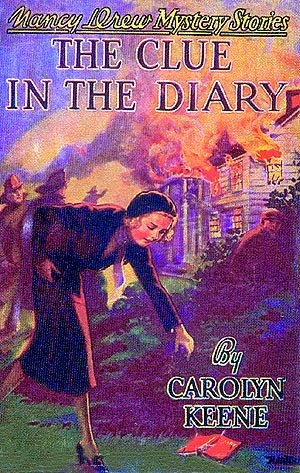
Nancy Drew mysteries have spanned decades and have needed updating from time to time. Here are two popular covers for The Clue in the Diary. I believe the one on the left is the original.
One of my all-time favorite books is Don't Look Behind You by Lois Duncan. It has seen several covers over the years. Here are three. The one on the left is my copy from 1989.
And how about The Giver by Lois Lowry? This left cover is the one I will forever identify with the book:
But the cover on the right I have seen often in classrooms and bookstores. It looks like a totally different book, doesn't it?
What are some of your favorite cover changes? Share them in the comments! :)
Book Nerd Tours is giving away a BLIND SPOT prize pack which includes signed copies of BLIND SPOT and DEAR TEEN ME as well
as BLIND SPOT swag. Click here for details and to enter.
Today marks the release of our very own Elisa Ludwig's PRETTY SLY, the sequel to her heart-pounding debut, PRETTY CROOKED, about teenage thief Willa Fox. PRETTY SLY, called a "crackling-good adventure" by Kirkus, asks the question, "What would you do if your mom disappeared and forbade you to come after her?" In between celebrations for her launch, Elisa bravely agreed to an interrogation about her writing process. 1) Something I'm dying to know: How did you research the terrific scene where Tre teaches Willa how to pick-pocket in PRETTY CROOKED? Heh heh. I used a combination of my own real life experience as a pickpocket victim, some shady websites and some very cool YouTube videos—there's a great BBC series called The Real Hustle, which gave me some interesting ideas for mixing up the thieving scenes. The reality is there's a lot of criminal how-to out there for the reading, but that could be a good thing, if people use it to avoid being victimized. 2) Can readers expect to see some familiar faces in PRETTY SLY (besides Willa and Aidan)? Did you pluck any smaller roles from the first book and give them a larger presence in the second book? Yes, the principle characters are all there, though the Glitterati only have a bit part, which turns the catty quotient in this sequel way down from the first book! I don't know that anyone has a larger presence but even the main characters in the first book are pretty mysterious and secretive, so the second book deepens our understanding of them—but also raises many new questions ... 3) How much downtime did you have between books? Was it easy or difficult to return to characters from the first book? I think I finished PRETTY CROOKED in February and started PRETTY SLY in May or June. Not too much time had elapsed, and I was working on copyedits and things while drafting the sequel so that helped keep everything fresh. I loved coming back to the same characters. It was so much easier to start a book in a place where I already understood my characters and their motivations. Sometimes that process alone will take a few drafts. It allowed me to focus on the increasingly more complicated plot! 4) Was your high school experience anything like the experiences of your characters? Was there a clear-cut line between the haves and have-nots? My high school experience was only similar in that I went to a private school and, as a middle class student, was very aware of class distinctions and how students communicated their status through clothing, cars, etc. While the mean girl behavior in my high school was much more subtle, there was certainly a sense that some (but not all) of the most privileged kids "ruled the school" socially. But I was definitely more of a fringe-y character than Willa. Like the Say Anything dudes say, "by choice, man." Or so I told myself! 5) What challenges did you face in writing SLY that were different from writing CROOKED? Was anything easier the second time around? I think the challenge with SLY was to make Willa's experience more difficult and keep turning those screws. This book has much higher stakes: she's in greater danger and she's also facing some really difficult emotional truths. The tone here shifts as a result, and keeping that in balance with Willa's bubbly personality and the lighter feel of the first book was at times tricky. On the other hand, I felt really lucky that SLY sends things in such a different direction that it truly felt like a whole new adventure to write. As I said, the characters were much easier the second time around, and I think I had a much better handle on the structure of the story from the very beginning. Also, it certainly didn't hurt that I was working with the same brilliant editors, so I always had their voice in my head when I was drafting, keeping me on course. 6) When you wrote PRETTY CROOKED, did you always know it would have a sequel, or did you envision it as a stand-alone? If you did map out the sequel early on, how much did the finished product of PRETTY SLY compare to your original plan? I always knew it would be a trilogy. Parts of PRETTY SLY were imagined originally as part of PRETTY CROOKED (through the first leg of their road trip, basically), but as time went on it became clear that Willa's time at Valley Prep really deserved its own book. That being said, all of the key clues except maybe a couple we added in copy edits were already in the first book when it came time to write the second. The third book was much more vaguely conceived going into it, and it probably changed the most dramatically in revisions—down to the actual answer to the mystery! 7) Besides Willa's vicariously satisfying Robin Hood-esque scheme of "spreading the wealth around" at her school, there is a second, overarching mystery about Willa's mother. When you have two (or three!) separate mysteries going on, how do you keep track of each person's head space at different points of their respective time lines? Oh, man. That's only the tip of the iceberg with this series! It can be tough, that's for sure. I wish I was one of those people who used Post-Its or a big magic marker or something, but truthfully, I just used a lot of Kanye West all-caps-esque notes to myself in the text as I wrote. Stuff like "REMEMBER: SHE ONLY KNOWS X,Y and Z, HERE!!!" and "HOW THE HECK IS SHE GOING TO COME TO THIS CONCLUSION?!!" 9) PRETTY CROOKED resolves certain plot elements perfectly, while still serving as a cliffhanger. Did you get any angry letters about the ending? Was it difficult to write a conclusion that leads directly into a new adventure? Yes! Maybe not super-angry, but a lot of teasing and frustrating ones. My editors and I went back and forth about where to leave things, and ultimately decided on the cliffhanger, which has its old-fashioned charms. I wouldn't say it was difficult to write that ending but I maybe felt a bit guilty to do that to readers. I hope PRETTY SLY will satisfy them! 10) I love Aidan and Willa's banter, as well as Willa's friendship-chemistry with Cherise and Tre. Do you have particular techniques you draw on to keep your dialogue so sharp? Thank you so much! I like to read dialogue out loud (if no one else is in the house!) to get a feel for how someone might really say something. And it's definitely something I fine-tune in revision, stripping it back more and more, because most people speak much more efficiently than I actually write. 11) When is book #3 coming out? March 2015! Check out the trailer for PRETTY SLY, below, and then enter to win a free copy of BOTH BOOKS!
After a
long, hot summer – we’re back and there are some really exciting things
happening at Sleuths, Spies and Alibis!
First –
the big news!
It’s a Sleuthapalooza
Giveaway!!
This is our biggest giveaway ever to
celebrate 2 years of our blog!
Enter below to win our books (signed
hardcovers, pre-orders and ARCs), plus swag! This is a great prize pack,
especially for teachers or librarians! (I may be a little exclamation point
happy today but 2 YEARS!!!)
Signed hardcover of Sarah Skilton's
BRUISED, and signed bookmarks for her forthcoming HIGH AND DRY
ARC of Lamar Giles's FAKE ID
Amazon pre-order of Elle Cosimano’s
NEARLY GONE
Signed hardcover of Ashley Elston's THE
RULES FOR DISAPPEARING and swag
Signed Hardcover AND signed
paperback of Diana Renn's TOKYO HEIST (plus crime scene tape and bookmarks)
Signed Hardcover of Talia Vance's
SPIES AND PREJUDICE
Signed Hardcover of Laura Ellen's
BLIND SPOT
ARC of Book 2 in the Deron Hicks's
THE SHAKESPEARE MYSTERIES series
Signed Hardcover of F.T. Bradley's
DOUBLE VISION
Signed Hardcover of Elisa Ludwig's
PRETTY CROOKED, and ARC of PRETTY SLY
To learn more about all of these books, you can scroll up to the"Our Books" tab or click here.
Also – I’m
super excited to announce we will have a new feature on the blog called REPEAT
OFFENDERS that will discuss the challenges of writing a sequel or second
mystery. Most of us here are either in the process of writing or launching book
2 so we know from experience how hard it can be. Jennifer Shaw Wolf will be on
the blog this month talking about the problems she encountered writing mystery
book #2. You will definitely want to check that out!
We’re
all really excited about the year to come and we’re so glad you’re here with
us!
This Friday, we're dragging welcoming New York Times and USA Today Bestselling Author Barry Lyga into our Interrogation Room to get some inside scoop on his latest novel GAME, the sequel to the acclaimed I HUNT KILLERS.
GAME is out on April 16th and available for pre-order now from your favorite bookseller. However, in anticipation of this killer (yeah, I did that) interview, we're raffling off a free copy to one lucky winner.
The giveaway will run through April 15th. Are you game?
I just finished reading Gone
Girl by Gillian Flynn. It isn't a book for a young audience, but I
couldn’t ignore the number of weeks this book spent at the
top of the NYT bestseller lists. The story centers around the disappearance of
a young woman on the morning of her fifth wedding anniversary, and a missing
person investigation that snowballs into a series of twists revealed through
the eyes of two unreliable narrators.
An unreliable narrator is often defined as a narrator whose credibility has been
seriously compromised. In some cases, the narrator is made unreliable due to
mental illness. In others, the narrator is deceitful, intentionally withholding
information from the reader. In either case, this narrative technique depends
heavily on the author’s ability to create an early connection between the
reader and the character, and then manipulate that relationship to keep the
reader turning pages, even while the reader begins to distrust that character’s
perception and interpretation of the events that follow.
Some recent examples of unreliable narrators in YA lit
include: Going Bovine by Libba Bray, The
Unbecoming of Mara Dyer by Michelle Hodkin, and Liar by Justine Larbelier. But
I am particularly intrigued with Hysteria, a newly released YA thriller by Megan Miranda,
which (like Girl Gone) employs a psychologically precarious and secretive
narrator to tease out a terrifying mystery.
Today, we’re turning the bright lights of the SSA
Interrogation Room on YA Thriller author, Megan Miranda. Megan is the author of Fracture (Walker/Bloomsbury, 2012), Hysteria (Walker/Bloomsbury, February 5, 2013), and VENGEANCE (Walker/Bloomsbury, 2014). She has a BS in biology from MIT and spent her post-college years either rocking a lab coat or reading books.
Here's a little peek under the stunning US and UK covers of her new book, Hysteria!
Mallory killed her boyfriend, Brian. She can't remember the details of that night but everyone knows it was self-defense, so she isn't charged. But Mallory still feels Brian's presence in her life. Is it all in her head? Or is it something more? In desperate need of a fresh start, Mallory is sent to Monroe, a fancy prep school where no one knows her . . . or anything about her past. But the feeling follows her, as do her secrets. Then, one of her new classmates turns up dead. As suspicion falls on Mallory, she must find a way to remember the details of both deadly nights so she can prove her innocence-to herself and others. In another riveting tale of life and death, Megan Miranda's masterful storytelling brings readers along for a ride to the edge of sanity and back again.
Hysteria's protagonist has been found not guilty by reasons of self-defense for
killing her former boyfriend. As the story unfolds, the reader is led at times
to question Mallory’s innocence, as well as her state of mind. Why did you
choose to present Hysteria through the eyes of an unreliable narrator?
First of all, thank you so much
for having me! Honestly, when I started the story, I didn’t think, “She’s going
to be unreliable.” And I don’t think I even realized it when I was drafting—I
knew she was skipping things, or choosing what to say, or missing elements—but
I didn’t put a name to it at the time. I think it’s a case of character and story
reflecting one another. In this case, the
story of HYSTERIA is able to exist because
she’s unreliable. What is haunting/stalking her, and why is it happening? And she’s unreliable because of the story (she does not want to remember—or talk
about—the horrible events that she was a part of). They developed off one
another, and I don’t think either would work on its own.
As authors, we
all go through our own discovery process as we develop our characters and get
to know them well enough to write their stories. Was your process different in
developing Mallory’s character as an unreliable narrator? In what way?
Mostly, it was the same way I’d
develop any character—by discovering through writing. But in this case, a lot
of the story elements have to do with the fact that Mallory isn’t sure if the
things haunting (or stalking) her are real or not. So there was a secondary
mystery, which is also part of the bigger plot—discovering who Mallory really
is, but through first-person narration. So it’s not that my process differed so
much—it’s more that the process took me in a different direction—more into her
psyche. It became a process to unravel Mallory, along with the external
mystery.
What challenges
did your unreliable narrator present while you were writing Hysteria, and how
did you overcome those challenges?
She’s a narrator who doesn’t
necessarily trust herself. And if she doesn’t trust herself, how can the reader
fully trust her, either? If the reader can’t trust her, how can they fully
connect to her? (This is something that’s really important to me, as connecting
to a character is the most important thing for me as a reader) I made the
conscious decision that Mallory would never overtly lie to the reader. She’s
unreliable, yes. But she does not lie, exactly.
She’s vulnerable, and she’s honest in her perceived assessment of herself. Instead
of viewing her primarily as someone who maybe shouldn’t be trusted, I tried to use that trait to make a connection. Not trusting yourself should be a
horrifying thing—and I tried to have that feeling translate, through Mallory,
to the reader.
What unique
opportunities does your unreliable narrator present in the context of
developing a thriller or mystery?
It allows you to create several
mysteries within the same thread. What’s happening externally, and what’s
happening internally? Are the things she’s showing us true? Are they all a
product of her mind? Is the danger out
there, or is it already inside her? In solving a mystery, she has to first
overcome herself before she can overcome the external factor.
I also think having an
unreliable narrator allows you to explore them more as a character inside the
thriller (why are they this way?), which is my favorite part of writing.
As a reader,
what are your favorite examples of stories featuring unreliable narrators?
Some of my favorite movies
feature unreliable narrators/main characters (The Usual Suspects, The Sixth
Sense). As for books, well Gone Girl is way up there for me. Life of Pi is
another. Most recently, Code Name Verity, which is unreliable because of its
structure—the story is told as a written confession, but we know it’s given
under duress, so the reader constantly wonders… is this true? I completely loved
it.
What’s coming
up, and where can readers find you?
Next up, I’ve got the
sequel/companion to my first book (Fracture), which comes out in early 2014. You can find me IN PERSON here(I’ll be on tour for HYSTERIA end of Feb/early March).
What writing secret will you reveal to us under the harsh light of the interrogation room lamp?
I rely on multi-colored
sticky-notes and multi-colored pens (and caffeine) for revising. It probably
looks like complete chaos to anyone else, but assigning colors to plot threads
helps me balance, and follow each arc. And I like seeing it off the computer
screen.
ELLE COSIMANO set aside a successful real-estate career to pursue writing. She lives with her husband and two young sons, and divides her time between her home near Washington, DC and a jungle tree house in the Mayan Riveria. Her YA novel NEARLY GONE will be published by Kathy Dawson Books/Penguin in Winter 2014, with a sequel coming in 2015. Learn more about Elle on her website, twitter, facebook, and Goodreads.