Showing posts with label For Writers. Show all posts

Thursday, May 23, 2013

A Method to the Madness?

Recently, while reviewing edit notes from my agent on my new project, she raised an interesting question about my primary antagonist- aka my bad guy: what motivated him to do the things he did? Was he crazy? Or was there some reason for his actions?

My first reaction was that he was crazy, because the things he does are violent and shocking, so they could only be the work of a crazy person.  But the more I thought about it, the more I realized that while his actions might be crazy, he was scarily sane.  He could rationalize each and every one of his violent acts.  He understood the consequences, and willingly accepted them. 

We've all heard the expression that every villain is the hero in their own story.  In all of my other projects, I could see that clearly, primarily because my antagonists weren't inherently evil, they just wanted something different than the main character, and they had their own reasons for wanting it.

But in this new project, the bad guys are BAAAAD.  And I've found that bad guys who are truly evil are hard to write without making them feel a bit like stereotypical super-villains.   Now that I knew my bad guy wasn't just a lunatic with an agenda, but a person with reason, I had to find a way to humanize him. And that's when I realized the comics had it right:  my super villain needed an origin story.

Every good super villain needs an origin story.  If we can catch a glimpse into the emotional trauma or events that shaped the way the character views the world, we can begin to, if not empathize, than at least start to understand how the character could do such inhuman things.  And, traces of his humanity need to show through at some point too. 

The bottom line:  my bad guy has too be more than his bad acts.  He's a son, a lover, a person who
needs and wants love and acceptance as much as anyone else.  And maybe it's his need for love and acceptance that allows him to be swayed toward certain actions.  Maybe he's conflicted about what he's doing.  Maybe he tries to stop.  But what if stopping leads to the death of the one person he really loved.  How would that guilt shape him?

Going through the exercise of trying to understand every aspect of my bad guy's motivations helped me to understand his actions as something more than just crazy acts of a crazy person.  These were desperate acts of a person who wants to be loved.

And that is a lot more interesting to write!

____________________________________________________________________________________

Talia Vance
 
 
Talia Vance is the author of Spies & Prejudice (Egmont, June 2013),  Silver (Flux) and it's sequel Gold (Fall 2013).  She has worked as a horse trainer, a freelance writer and an attorney.  She lives in Northern California with her husband, children and a needy Saint Bernard named Huckleberry.  Talia always thought she’d grow up to write “the Great American Novel” but her tastes ran more along the lines of torrid romance and fast-paced thrillers. So did her life.  But that's another story.

Tuesday, April 9, 2013

The Mystery of the Disappearing Hours (or, Finding Time to Write)

One of the number one questions I’ve gotten this year as I’ve done book events for Malcolm at Midnight is: “How do you do it? How do you work full-time and have two kids and still find time to write?”

The question flummoxes me a little because I don’t have a good answer. Truthfully, most days, I’m frustrated with my lack of writing time. I don’t feel like I do a good job of it. I am an incredibly S L O W writer. But people don’t want to hear that. They want to hear about a magic formula to increase word count or some nifty trick to sleeping less—or maybe even that I’m making ridiculous sacrifices they would never, ever consider: “Well, I buy my kids disposable clothes." Or, "We only eat drive-through, except on third Sundays.”

But if I’m being kinder to myself, I actually DO write. I have published books, so there is physical proof of it, even if it feels like I don’t. Yes, I wish I could write faster and more efficiently. But I am writing. And I do--somehow--make time for it.

Here are my secrets to writing in the midst of busy-ness.

I find the time because I like it.

I haven't watched a Packer game since
they won the Superbowl.  (This is
probably actually considered a ridiculous
sacrifice for most Wisconsinites.)
One of the best things about having a “day” job, is that I don’t HAVE to write. I have a steady income. I have insurance. I have a retirement fund. Any writing that I do is purely because I WANT to do it. Sometimes I tell myself, “Don’t feel like writing? Then don't. Quit.” But I always come back to it. I enjoy writing. Others shop or watch the Packers or scrapbook or bake in their spare time. I write.

I don't have a writing time or place. 

If I waited for “writing time,” it would never happen. I have to constantly be on the offense and aggressive about compiling bits and pieces of time to write. Get up a half hour early. Write for 15 minutes during lunch. Write while the pasta boils. Be the anti-social parent who writes in the car while waiting for baseball practice to be over. If you do this regularly enough, eventually, there is something long and book-like.

I write, even when I don’t want to.

Lest you think it’s all hearts and daisies…yes, there are some days I don’t want to write. Many, many, MANY days--when I’m tired, grumpy, and lazy. And on those days…I make myself write. Because that’s what writers do. On those tired, grumpy, lazy days, I ask myself, “Do you want to be a writer? Or do you want to watch Dancing with the Stars?”

I embrace the low-tech. 

There’s a lot of discussion about what online presence sells books best. I cling to the train of thought that writing another book is the best use of my time. I cling to it because it’s the only option I have. There’s not time to do it all. So I’ve let go the blogging, the tweeting, the Tumbling, the Facebooking. I’m on those places, but I’m not a Voice. Or a Platform.

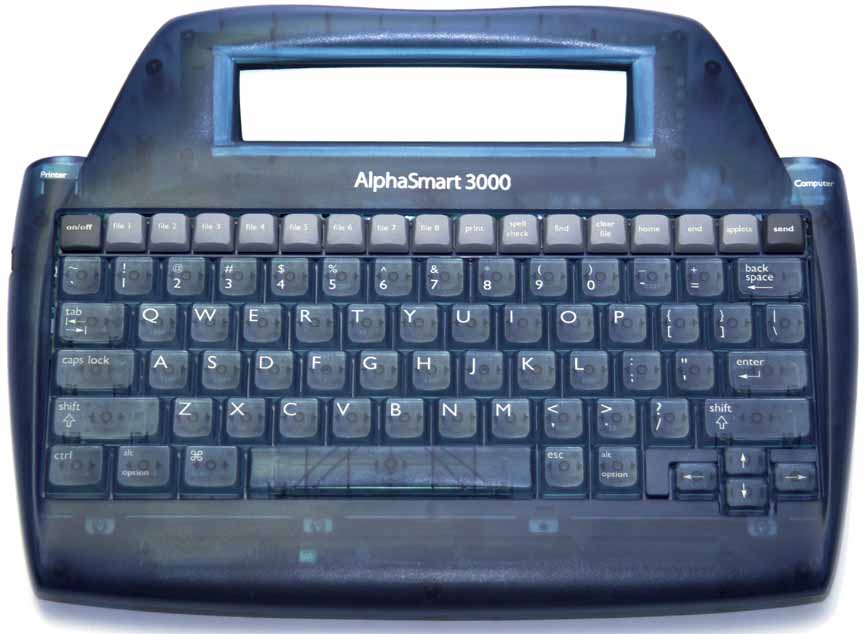
This stupid AlphaSmart has eliminated
 most of my excuses—my laptop is
 running updates, my hand hurts
when I write long-hand, we’re camping/there’s 
no electricity, I just need to respond to this 
Facebook post really quick
for not writing in the little spaces of my day.
I also have some really old technology in my arsenal: an AlphaSmart. We had these back in the day when I first started teaching. You can only type on the thing. There’s no clicking. No web surfing. No formatting. No word count checking. You type, then you plug it into your computer, hit “send,” and your words spill out into Word or Scrivener or wherever you designate.

It’s ugly. I get funny looks. But it’s lightweight, take less than a second to boot up, is virtually indestructible, the batteries last eons (maybe literally; I’m on my second year with the same AA’s!), and there’s NO INTERNET.

I have a secret weapon.

Here’s where my tips may become less helpful to you. Because you might not have access this secret weapon. And if you don’t, well, most of my list is a lot harder to do.

What is it? I have a family—a large, extended family—that supports my writing like crazy. Like CRAZY.

My birthday presents consist of things like new slippers (a writer’s “uniform”), gift cards to coffee shops, and starter funds for housecleaners. My family talks up my books everywhere they go. They attend my book events, even when they’ve heard the speech seventeen times. They keep the laundry and the errands and the meals flowing when I have a deadline or go away to events they can’t attend. They listen--without rolling their eyes--as I debate things like, what kind of injuries would a rabbit get, falling out of a clock tower?

Over and over again, they give me their time and encouragement to keep writing. It’s huge. If you have people like this backing you up, well, it makes every “secret” listed above a lot easier to do.

So, yes, there is not a lot of time to write while working full-time at another job and parenting two busy kids, but it can happen. It DOES happen, word by word, day by day…if you decide you want it to.

And you can even do it without magic formulas, nifty tricks, or having your kids eating drive-through every night.

___________
W.H. Beck is an elementary school librarian by day and mystery writer by night. Her website is here: http://www.whbeck.com.

Thursday, August 30, 2012

Breaking The (Writing) Rules By Opening With The Weather

"It was a dark and stormy night." I love that line. I know, it gets quoted all the time when people talk about that ol' writing rule, the one that tells you to never open with the weather.

I think that's a stupid rule (she says while stomping her feet).

Think about it: weather carries all kind of inherent drama. As I'm riding out the remnants of Hurricane Isaac, I secretly think of all the cool stories that can come from a storm like this:

A body washes up in the flood, but autopsies show the murder was committed last year.

An evacuee goes missing, but leaves clues on her way north.

A bag of money is found in a soggy attic/bedroom wall (can you picture someone hanging hundred dollar bills out to dry, deciding what to do?)

From these examples, you can tell I'm a mystery writer. With all respect to the real-life misery disasters can bring, as a writer, I love the potential drama: hurricanes, blizzards, tornadoes--why not use them to start a story? And why not open with that dark and stormy night? Seems like the perfect way to tell us there's a mystery coming...

How about you, fellow writers? Ever used the weather to bring some drama to the page?


Tuesday, June 26, 2012

Criminal Writing Offenses In KidLit: The Important Life Lesson


There’s a secret to writing middle-grade—well actually, it’s not all that much of a secret. To write for the eight-to-twelve year-old kid, you have to be able to think like a kid. Remember what it was like to have your lunch stolen (or maybe just your pudding cup, but that’s bad enough, wouldn’t you say?). Feel that brick in your stomach when you’re bringing a bad report card home. Stick out your tongue and get stuck to a lamppost, or at least imagine it (since that one's sort of a bad idea and all).

When I wrote DOUBLE VISION, that connection to a twelve year-old was the most important and enjoyable part of writing Linc Baker’s (that’s my main character) story. I want my books to be fun reads, and hope to keep that kid connection going as I write the series sequels. It's fun to be twelve, even if it's just pretend.

So to me, the biggest crime a writer of middle-grade or YA can commit is to lecture to kids. I hate it. And it happens far more often than you’d think. I can’t count the times that an aspiring MG writer has told me: “I want to write my book so I can teach kids that (bullying, cheating—fill in the life lesson) is bad.

Don’t get me wrong—I get the intention of these writers. The truth is, there are many published books that have these life lessons clearly stated on the page. Usually, there’s some sort of wise grown-up delivering that message. And I think those message-driven books are a crime—just my opinion, but I’ll bet if you ask a random MGer that they’ll pass on the lesson too.

Here’s why I think this kind of writing is a crime:

1. Kids don’t need another lesson.
Think like a twelve year-old for a second: how many times a day are you told to do something, act a certain way, stay in your seat, finish your dinner—I could go on for a while, but you get my point. Kids get told what to do all day long.

2. Reading should be fun.
Do you like life lessons woven into your nighttime blockbuster read? I sincerely hope not. Let’s leave the afterschool specials in the eighties, where they belong. Reading mysteries should be fun.

3. It’s cheating.
Now, we all want to say something with our fiction, right? But being didactic with your important life lessons is just plain cheating as a writer—it’s the ultimate violation of the show-don’t-tell rule. Instead of telling your kid reader that he shouldn’t cheat on his test, show him the consequences. And add a good bicycle chase scene while you’re at it—those are so much more fun anyway.

4. We want kids to keep reading.
This one’s sort of obvious, but do you think kids will pick up books after the required reading is over if we cram them full of Valuable Life Lessons? Of course not. Make your story fun. Leave the lessons for Mom, Dad, teachers, and other parental types. They've got it covered, trust me.

I’m all for having something to say—I’m pretty opinionated myself, as you can probably tell. But write your books from the kid perspective, my fellow writerly people, not from the adults’. Or I may just come over and roll my eyes at you. Don’t say you weren’t warned.

How about you, Sleuths and Spies? Any criminal writing you want to share?
Related Posts Plugin for WordPress, Blogger...