Showing posts with label mysteries. Show all posts

Monday, March 17, 2014

Interrogation Room #38: Laura Marx Fitzgerald (UNDER THE EGG)

When we sleuths picked up chatter about a fantastic new debut novel in the vein of CHASING VERMEER and FROM THE MIXED UP FILES OF MRS. BASIL E. FRANKWEILER, we had to track down its author, Laura Marx Fitzgerald. Today -- on the eve of the release of her much-anticipated UNDER THE EGG, we've managed to haul Laura into the Interrogation Room.


When Theodora Tenpenny spills a bottle of rubbing alcohol on her late grandfather’s painting, she discovers what seems to be an old Renaissance masterpiece underneath. That’s great news for Theo, who’s struggling to hang onto her family’s two-hundred-year-old townhouse and support her unstable mother on her grandfather’s legacy of $463. There’s just one problem: Theo’s grandfather was a security guard at the Metropolitan Museum of Art, and she worries the painting may be stolen.


With the help of some unusual new friends, Theo's search for answers takes her all around Manhattan, and introduces her to a side of the city—and her grandfather—that she never knew. To solve the mystery, she'll have to abandon her hard-won self-reliance and build a community, one serendipitous friendship at a time


And here's a bit about Laura: 


Laura moved around a lot as a child, living everywhere from Norman, Oklahoma to Pensacola, Florida. A Harvard graduate and former copyeditor, Laura never imagined she'd write a novel until she had an idea about a girl who discovers a stolen painting in her attic. That novel is UNDER THE EGG. Laura lives in Brooklyn with her husband and two kids.


UNDER THE EGG is an Indie Next pick and has been selected as one of Amazon's top spring titles. It releases on March 18th (tomorrow!). We feel lucky we managed to nab Laura first....


1. What inspired you to write UNDER THE EGG? Do you have any unique experiences or interests that drove you to develop the story?

I studied art history in school and, honestly, found it a disappointing experience. I realized that what interested me was the stories art inspired, not the specifics of brushwork or provenance. Twenty years later I was watching Antiques Roadshow, and I was struck by how it captured what makes art interesting for most people. Where did the piece come from? Who made it? Why? What story is it telling? How did it get here?

Around that time, I was reading a fantastic book by Edward Dolnick called The Forger’s Spell, whenthese three lines jumped out at me:

The easiest test of an old master—and the one test almost certain to be carried out—is to dab the surface with rubbing alcohol. In a genuinely old painting, the surface will be hard, and the alcohol will have no effect. If the painting is new, the alcohol will dissolve a bit of paint, and the tester’s cotton swab will come up smudged with color.

That gave me the idea that someone might intentionally paint over a more valuable painting, with the plan to later remove the top layer. All those Antiques Roadshow questions came back to me—who made it, and how did it get here?—and Under the Egg was born.


2. What is the most challenging thing about writing a mystery for young readers? What's the most rewarding part?

I was absolutely blown away by The Westing Game as a kid. I started re-reading it as soon as I finished to see how all the pieces fit together. When I decided to write a mystery, I wanted it to do the same thing for the same audience.

What I admired about The Westing Game too is that the book doesn’t shy away from adult topics.Bombs, bookies, religious extremism, and degenerative disease all make an appearance in the book. I find the subjects that interest me lie squarely in the adult world, while my ideal audience is much younger. That means I have to work hard to find ways to make these concepts understandable and digestible for middle grade readers.

After all, what are the middle grade years for if not to uncover all the secrets adults have been hiding from you?

3. What is your writing process like?

I always start off with lots of reading and research. I love discovering the impossible-but-true stories that have been lost to history, so I follow the stories from one book to the next. For example, my reading for Under the Egg led me from The Forger’s Spell to a book about the widescale Nazi looting during World War II to The Monuments Men (the source for the recent George Clooney movie). Elements of each book made it into Under the Egg.

Once I’m ready to outline—and I live and die by a meticulously detailed outline—there’s an enormous amount of procrastination, punctuated by fluctuating spells of crushing self-doubt and manic creative energy. But once the outline is finished, then I get down to business: 9:00a.m.-12:00p.m. Monday through Friday, at my computer until I have a draft.


4. What have been some of your favorite mysteries, real-life or fictional?

The Name of the Rose. Possession. The aforementioned Westing Game. And Encyclopedia Brown, of course.

5. What is something that no one knows about you?

I've never read A Wrinkle in Time.

6. What writing secret will you reveal only under the harsh glare of the interrogation room lights?

As long as you’re wearing gym clothes, the people at the YMCA Childwatch will think you’re dropping off your kids to work out and not to revise your draft in the hallway.

Leave it to a mystery author to have a sneaky trick up her sleeve. Congratulations on your debut, Laura. We were thrilled you took the time 

Want to learn more about Laura?


Follow her on Twitter @MarxFitzy

Tuesday, October 22, 2013

The Mystery of the Common Core

Say the words “Common Core” to a teacher or librarian and get ready to hear some heavy sighs. It’s exhausting hearing about one topic so much, let alone figuring out how to align curricula to it.

However, as far as I can tell, the fairly open-ended standards of the Language Arts Common Core mean that just about any novel can go along perfectly with them! What novels don’t have themes or settings or points-of-view to discuss?

I’d like to make a case that mysteries, in particular, are a great fit:

1) Mysteries reward close reading

Looking carefully at a text and citing examples for interpretations is a major focus of the Common Core. With possible clues hiding at every turn, a fast-paced mystery with substance can keep students focused and immediately understand the rewards of paying close attention. It’s much more fun to look at how lines reveal character (CCSS.ELA 8.RL.3) when figuring out which characters are trustworthy and which are suspects, isn’t it?

2) Mysteries encourage analysis, making predictions and drawing inferences


Reading mysteries are all about subtext, making logical deductions, and predicting what’s going to happen next – all bedrocks of the Common Core.

 In fact, several of the standards even seems especially designed for mysteries: “Analyze how differences in the points of view of the characters and the reader create such effects as suspense or humor.” (RL8.6) or “Cite textual evidence to support analysis of what the text says explicitly as well as inferences drawn from the text.” (RL.6.1)

(Though I wish students good luck analyzing what makes something funny. I'm not sure anyone has ever succeeded at that.)

3) Mysteries are high-interest but also often have significant “text complexity”

The Common Core focuses on deeper comprehension of challenging texts as a way of counteracting our culture of skimming. Mysteries are by their very nature complex – they have to be to avoid being totally predictable! Plot twists, non-linear narratives, and a large cast of characters are common. Best of all? Mysteries don’t seem complex or impenetrable; kids are highly motivated to keep turning the pages to get to the resolution.

4) Mysteries inspire fun potential writing assignments (that meet the CCSS standards)!

A key part of the standards revolves around writing persuasively: how do you support an opinion with evidence? This could be an especially fun assignment when it comes to a mystery! Students can put forth their own theories about suspects as they read and present their reasoning to classmates.

Of course, narrative writing is an important part of the Common Core, as well. I may be biased, but what’s more fun than writing your own mystery?

Hope you’ll check out our books to see if any might be a good mystery choice for your class. You could even win one if you act fast - F.T. Bradley's DOUBLE VISION: CODE NAME 711 is hot off the presses and we're running a contest through the end of today.

Note: You can find a CCSS-aligned discussion guide for The Wig in the Window here. Interested in a 20 minute Skype session for your class? Let me know. They are free for any class who's reading the book (I'm all full for the fall but am currently scheduling for the winter and spring.)


-----------------------------------------------------------------------------------------------------------------------
Kristen Kittscher was a child neighborhood spy but (allegedly) grew up to be an upstanding citizen, seventh grade English teacher, and writing tutor. A graduate of Brown University, she lives in Pasadena, California with her husband, Kai. The Wig in the Window is her first novel. Visit kristenkittscher.com to investigate more about her.


Wednesday, June 26, 2013

Interrogation Room #30: April Henry, THE GIRL WHO WAS SUPPOSED TO DIE


We’ve got another suspect in the Interrogation Room! Today April Henry has been hauled in, accused of murdering people on paper – something she freely admits to on her website. Here’s what our detective Laura Ellen uncovered:


Suspect’s Bio:


April Henry knows how to kill you in a two-dozen different ways. She makes up for a peaceful childhood in an intact home by killing off fictional characters. There was one detour on April's path to destruction:  when she was 12 she sent a short story about a six-foot tall frog who loved peanut butter to noted children's author Roald Dahl. He liked it so much he arranged to have it published in an international children's magazine. By the time she was in her 30s, April had started writing about hit men, kidnappers, and drug dealers. She has published 15 mysteries and thrillers for adults teens, with more under contract.


Books:


The Girl Who Was Supposed to Die is April Henry’s most recent crime.
“Take her out back and finish her off.”

She doesn’t know who she is. She doesn’t know where she is, or why. All she knows when she comes to in a ransacked cabin is that there are two men arguing over whether or not to kill her.
And that she must run.

This nail-biting thriller involves murder, identity theft, and biological warfare. Follow Cady and Ty (her accidental savior turned companion), as they race against the clock to stay alive.

Other books for teens by April Henry:
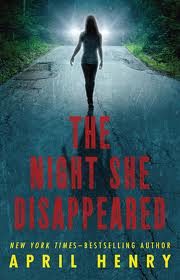
 The Night She Disappeared
Girl, Stolen
Torched
Shock Point
And several books for adults. See her website for a list
 
Now for our interrogation!


Interrogation:

April, on your website you say: “I kill people, but only on paper” -- your latest book, The Girl Who Was Supposed to Die definitely fits this MO as it begins with your main character about to be finished off by two men!
Tell us about your career path. How did you begin writing thrillers and mysteries? What drew you to this genre? What is it about killing people on paper that you love so much?
I started writing around my 30th birthday. I wrote one book that got rejected by dozens of agents. The next book was picked up by an agent (and we’re still together nearly 20 years later), but just garnered nice rejection letters from editors. The third book didn’t even get very good rejection letters. My agent said she thought the fourth book would sell as a mystery. I told her I didn’t care what she called it, I just wanted to be published. 
Mystery is a very flexible genre - it can be literary or formulaic or something in between. I like reading page-turners and I like writing them, too. While I’m a nice person in real life (I have a hard time not apologizing to my sparring partners in kung fu), it’s kind of fun to imagine being a bad guy or gal.
I don’t want to give anything away (I hate spoiler reviews and interviews!) but it is obvious you had to some research for The Girl Who Was Supposed to Die. How do you go about researching? Do you just internet browse or do you go out and interview experts?

I went into the story knowing I wanted the girl to not remember anything, and knowing what had caused that. I did not know why the two men wanted to kill her, where her family was, etc. That took forever. Tons of brainstorming. I ended up doing a lot of research into how to make bioweapons (it’s a wonder the FBI did not come for me) and ultimately ran several chapters past Dr. Denene Lofland, who has worked in anti-bioterrorism with a secret security clearance. She told me my scenario was “plausible and evil.”

Plausible and evil - nice! I think :) You write for both adults and teens. Do you prefer writing one more than the other? When you sit down to write something new, how do you decide if it is going to be for adults or teens? Do you write it first and then see where it falls, or do you know before you even start plotting who the audience will be?
If my main character is a teen, then it’s a YA. An adult, an adult book. I have really come to love writing for teens. They are fresh and full of energy. They don’t hide their feelings. I get probably 20 emails a week from teens. Of course, sometimes they will tell you that your book is the best they have ever read, and you later learn it’s the only book they’ve ever read all the way through.
And what an honor to be that author who got a teen to read a book all the way through for the first time! One of your adult series you co-author with Lis Wiehl. Tell us a little about the process. Do you plot together, take turns writing, etc.

Lis is a TV reporter, and has been a federal prosecutor. Her dad was an FBI agent. We come up with plots that reflect her interesting background, then I’ll work on a first draft in consultation with her.  Then together we work to create the final draft. 
Speaking of series, you have a very intriguing new YA series coming out soon. Can you tell us about it?

I’m excited for my new Point Last Seen series. The first is due out in 2014. I got the idea after talking to a friend’s teenager. She volunteers with Multnomah County Sheriff’s Office Search and Rescue. Like most groups, MCSO SAR looks for people who are lost in the natural areas. What makes this group unique is that it’s a teen-led group . While there are adult volunteers, they can’t be leaders.  The second thing that sets it apart is that 30-40% of what they do is crime scene evidence recovery, including recovery of human remains. Many of the volunteers are interested in future careers in law enforcement or crime scene investigation.  I have been taking classes with them and going out on training exercises.

Oh my gosh that sounds so cool -- what an awesome opp for those teens! I really look forward to reading the first book in the series. One last question before we let you go. All of your crimes are set in the Pacific Northwest. Do you do this because it is what you are familiar with and does it ever limit you in any way?
I grew up here.  I could not realistically set a book in Nashville or New Orleans or New York.  I’m not of those places.  However, I don’t think it’s limiting.
Just like the film makers who have turned Toronto into whatever city in the world they need, the Pacific Northwest offers enough variety for a thousand writers. We’ve got cities and tiny towns. You want deserts? We’ve got ‘em. Caves? Ditto. Mountains perfect for concealing shallow graves, coastlines where a body might wash up, lonely forests where no one will hear your poor character scream, even freak windstorms strong enough to flip semis on their sides.
Spoken like a true thriller writer!
Before we release you, tell us where we can find you.

I do a lot of school visits these days, so if you know of a middle school or high school that has authors come to speak, have them contact me. You can find me on my website: aprilhenrymysteries.com and I am also on Facebook: www.facebook.com/AprilHenry
and Twitter: @aprilhenrybooks

Thanks April!


Thursday, January 17, 2013

The Writer Who Knew Too Much

I'm working on the final installment of Willa Fox's adventures right now and hitting the typical Third Book Problems. By the time you write up to the end of a trilogy, the plot should thicken, the emotional stakes should be raised even higher and it all needs to resolve in a satisfying way that does the previous two books justice. Yeah, no biggie.

One of the trickiest things I find about maintaining the mystery at this stage is knowing too much. Obviously, as the author, you know exactly what's going on and how things will end up, and all the intricate backstory that explains everything. But sometimes that knowledge can be a burden. I find that in the early drafts I tend to lead the reader right to the X that marks the no doi. It's only in the revision process that I can start to detach, complicate the situation, create some red herrings or some incorrect assumptions.

Struggling with knowing too much? Here are a few tricks I have learned and some questions to ask yourself:

1) How could a reader misinterpret the existing clues? Can your MC get tripped up by a detail or two?

2) Is there dialogue that can be more elliptical? People don't always speak in a literal manner and your characters shouldn't, either. Can you play up a misunderstanding?

3) Are there mini mysteries within your overarching mystery that can be teased out to distract your reader and your MC from the truth?

4) What qualities, characteristics or motivations can you add that might complicate the reader's opinion of the possible suspects?


Thursday, May 24, 2012

Writing DNA #12

In yesterday's interview with debut author Jennifer Shaw Wolf, the subject of 'memory' came up while we interrogated her about her awesome novel BREAKING BEAUTIFUL. Allie, the novel's protagonist, is trying to reconstruct the memories of a tragic night. It occurred to me that, as writers, sometimes our stories can resemble reconstructed memories of events in our own lives.

The old edict is 'write what you know', but it might be better stated as 'write what you remember'. Or better still, 'write better than you remember'. I've noticed in my own writing that settings, people, and events might start out as close approximations to real-life inspirations from childhood and beyond. But, we're talking about fiction, so real-life is but a spark*. The resulting flame is so much brighter/hotter/dangerous than what came before it.

I wonder...do any of you have super vivid memories that could serve as inspiration for a story? If so, how can you make those memories even more fantastic (while changing names to protect the innocent...remember, fiction...fiction)?

While you think it over, be sure to checking out BREAKING BEAUTIFUL and our Interrogation Room interview with Jennifer Shaw Wolf.

*Real-life is also where the lawyers live. If I write about real people and places (particularly when it involves grisly fictional crimes), I might be looking at some lawsuits sooner than later. I don't want to look at lawsuits sooner than later, so I don't write about real people and places.

Thursday, February 9, 2012

DNA #8

In honor of Valentine's Day, this week in DNA we're looking at the magic of sidekicks in mysteries. Here's what our detectives have to say about it.


Laura Ellen: What would Sherlock be without Watson? Frank Hardy without his brother, Joe? Nancy Drew without her friends Ned, George and Bess? Every good sleuth needs an assistant. But why exactly?
An assistant can push your sleuth to take a risk, to look at something or someone in a different way, to make the right decision . . . or a wrong one. Assistants or sidekicks or partners in crime—whatever you call them—they are an author's best tool for pushing plot forward while deepening character.

I love the sleuth/assistant relationships where there is a lot of bantering going on between the two, where each character brings out the best and the worst in each other, highlighting each other's strengths and weaknesses, at each other's throats more often than at peace—but are also always on the same page when it counts. And because I love me some romance with my mystery, my sleuths and their assistants are almost always boyfriend and girlfriend—even if they don' know it yet. That extra tap-dancing that comes into play when the heart is involved adds an extra layer of tension that I just love writing.

Elisa Ludwig: Our characters, just like people in real life, get by with a little help from their friends. In Pretty Crooked, Willa conducts most of her covert activities on her own, but when her mom starts acting strangely, she does get some assistance from her best friend Cherise. In one particular scene, they set out to tail Willa’s mom, and for me, this was one of the most fun moments in the book.

For one thing, the dialogue flowed really easily between these two characters, with Cherise
drawing some conclusions that Willa just doesn’t want to hear. For another, it was an opportunity to bring it back to the teen experience—Willa is doing a lot of grown up (and illegal) things in this book but when she’s with Cherise she’s undoubtedly a 15 year-old girl. Finally, your protagonist simply can’t figure everything out on their own, so having a sidekick there can really take the burden off of them and advance the fact-finding process.

Diana Renn: I love a strong, independent sleuth, but that doesn't always translate to excitement on the page. A sleuth working on her own too long means too much time in her head, or voicing rhetorical questions to an empty room, or Googling stuff (yawn). Talking through clues and and strategizing with a sidekick is way more interesting, and inevitably leads to action . . . if a plan is dreamed up, it must be acted upon! I love sidekicks so much I actually have two of them in Tokyo Heist, one in Seattle and one in Japan, since my main character has to travel. Sidekicks can be sounding boards, skilled experts, love interests, best friends, occasional rivals, comic relief . . . the possibilities are endless.

Thursday, December 1, 2011

Undercover #5

Time to check in and see what our detectives have been reading lately!


Diana Renn:  I'm re-reading THE CHRISTOPHER KILLER by Alane Ferguson. Warning: it's not for the faint of heart, or for the very young reader. The teen sleuth, Cameryn, is the daughter of the county coroner in a small town in Colorado, and she aspires to become a forensic pathologist. She's up close and personal with dead bodies and autopsies, and you'll learn more than you might have wanted to about this science. But wow, wow, wow, what a mystery. I really couldn't figure out who did it until the end. Expert use of red herrings, suspects, and reveals, in unpredictable ways. Here's what I really love: Ferguson takes a dark premise (a girl trying to track down a serial killer, who has just killed someone she knows) and shines the light into it. There is opportunity for spiritual reflection and growth, for dealing with the reality of loss, and even -- incredibly -- humor. I'm reading it again to figure out how she pulled off this incredible high-wire act.


W.H. Beck: I just finished ICEFALL by Matthew Kirby over Thanksgiving. I actually read it all in one gulp--it was that good. Set in the north in the time of beserkers and Vikings, overlooked second daughter Solveig and her siblings are sent to live in a distant fortress on a fjord when their father, the king, goes to war. Once the fjord freezes, they will be safe from any invaders. Only it slowly becomes clear that, even though they are with their father's most trusted servants and guards, there is a traitor among them--and now that the fjord is frozen, they are all trapped. Will they survive? Who is the saboteur? Is their father winning or losing his war? As Solveig grapples with these questions, she also learns the power of Story from her father's skald and starts to figure out what her own power might be. A locked-room mystery with characters to cry over, an unusual setting, and important themes. Loved it.


Kristen Kittscher: I'm finally reading the 2009 mystery THE SWEETNESS AT THE BOTTOM OF THE PIE, 70-year old Alan Bradley's brilliant debut, which has me hoping he'll be writing well into his 90s. I'm a sucker for precocious young protagonists, and -- while this is not a YA title -- it features one of the most entertaining young geniuses you'll ever encounter: eleven year old Flavia De Luce, a budding chemist whose wry, deadpan observations about her world light up this funny, clever cozy-esque mystery set in 1950s England. Though not a fast-paced book, it's a tale that bookish teens are just as likely to enjoy as adults. 


Elisa Ludwig: I'm reading NOTHING by Janne Teller. Talk about dark! This book is extremely creepy and bone-chilling, but brilliant in its simplicity.
Related Posts Plugin for WordPress, Blogger...